The Geology Under Your Feet: Glacial Till and Shale in Summit County
If you live in Akron or anywhere in Summit County, the soil beneath your home has a story that goes back thousands of years. As glaciers retreated across northeastern Ohio, they left behind a dense, unsorted mixture of clay, silt, sand, and rock known as glacial till. This till is often dominated by clay particles that are incredibly fine, and that fineness matters enormously when it comes to water management around your foundation.
Beneath that till layer, much of the region sits on shale bedrock. Shale is composed of compressed clay and silt that breaks into thin, flat layers. While solid shale can act as a barrier, weathered or fractured shale near the surface allows water to move along those layers. When heavy rain saturates the glacial till above, the water hits the shale and has nowhere to go but sideways, often directly toward your basement walls. This combination of clay-rich till over shale is a big reason why Basement Waterproofing is such a common concern for homeowners in this part of Ohio.
Why Akron Clay Soil Pushes Water Toward Your Foundation
Clay is not just dense; it is also highly expansive. When it absorbs water, it swells. When it dries out, it shrinks. That constant cycle of expansion and contraction puts tremendous pressure on foundation walls. Over time, this soil movement can create the hairline cracks and wider fissures that let water seep into your basement. Homeowners in Cuyahoga Falls and Stow see this same pattern because the same glacial till underlies much of the area.
Compounding the problem, clay does not drain well. Instead of letting rainwater percolate down to the water table, it holds moisture against your foundation like a wet sponge. During a wet spring, the soil around your home can become saturated for weeks. Hydrostatic pressure builds up, and water takes the path of least resistance: through cracks, through porous concrete, or through the joint where the wall meets the footing. This is why so many Summit County basement leaks appear after prolonged rain rather than during a single storm. The soil simply cannot release water fast enough, and your foundation bears the brunt of it.
Glacial Till Foundation Cracks and Shale Foundation Seepage: What to Watch For
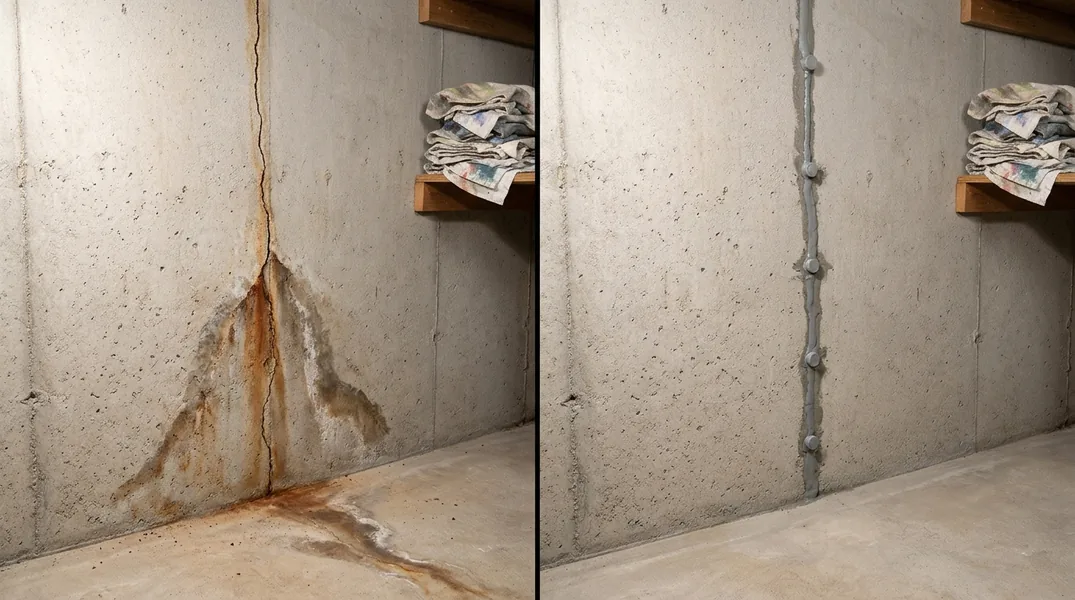
Not all foundation cracks are equal, but in Akron clay soil, certain patterns should raise a red flag. Vertical cracks in poured concrete walls are often caused by shrinkage and are usually minor, but they can still let water in. Diagonal cracks that start near the corners of windows or doors can indicate settlement or soil movement. Horizontal cracks are the most serious because they often signal that expansive clay is pushing against the wall with enough force to bow it inward. If you see any of these, it is worth having a professional evaluate the situation before small issues become structural repairs.
Shale foundation seepage tends to show up differently. Because water moves along the bedding planes of the shale, it can emerge at the base of the foundation or through the cove joint where the floor and wall meet. You might notice efflorescence, that white powdery residue on the walls, which is a sign that water is moving through the concrete and leaving minerals behind. Musty odors, damp carpet edges, and rust on basement appliances are other clues. Homeowners in Tallmadge and across the region often describe a damp feeling that never quite goes away, even when the weather is dry. That is the signature of clay soil holding moisture against the foundation long after the rain has stopped.
How Soil Movement Affects Your Foundation Over Time
Soil movement is a slow but relentless force. Each wet season, the clay swells and pushes. Each dry season, it shrinks and pulls away, leaving gaps along the foundation that fill with water during the next rain. This cycle repeats year after year, gradually widening existing cracks and stressing the structure. In some cases, the movement is enough to cause sticking doors, uneven floors, or cracks in interior drywall. Those interior symptoms are often the first thing a homeowner notices, long before they see water in the basement.
Because the problem is driven by the soil, surface fixes like patching a crack from the inside rarely solve it for long. The pressure will find another weak point. A more reliable approach is to address the water before it reaches the foundation or to manage it once it arrives. That is where a professional assessment can save you time and money. Foundation Waterproofing strategies are designed around the specific soil conditions on your property, not a one-size-fits-all solution. If you are unsure whether soil movement is affecting your home, a free estimate can give you a clear picture of what is happening and what it will take to fix it.
Basement Waterproofing Near Me: Solutions for Summit County Basement Leaks
When Summit County basement leaks are caused by clay soil and shale seepage, the most effective solutions manage water at the source and redirect it away from the foundation. An Interior Drain Tile System captures water that enters through the cove joint or wall cracks and channels it to a sump pump, keeping the basement dry even during extended wet periods. This approach works well for homes where exterior excavation is impractical or where the water table is high.
For homeowners who want to stop water before it reaches the wall, Exterior Basement Waterproofing involves excavating around the foundation, applying a waterproof membrane, and installing drainage to move water away. This can be especially effective in clay-heavy soils where hydrostatic pressure is severe. Many homes benefit from a combination of approaches, and the right choice depends on your specific soil, foundation type, and drainage patterns. If you want to understand what a solution might look like for your home, call Akron Waterproofing at (330) 315-1186 to schedule a walkthrough.
Basement Waterproofing Cost in Akron: What to Budget
Homeowners often ask what pricing looks like for basement waterproofing in this region. The honest answer is that cost varies widely based on the size of the basement, the severity of the water problem, and the solution chosen. A simple crack injection is far less expensive than a full interior drain tile system, and exterior work typically costs more because it involves excavation. Soil conditions also play a role: clay-heavy sites can require more extensive drainage planning than sandy soils.
Rather than guessing, the best approach is to get a written estimate that explains exactly what is included. A reputable contractor will inspect the foundation, identify the source of the water, and recommend a solution tailored to your home. Be wary of any quote that does not include a site visit or that promises a universal fix. For a straightforward conversation about your options and a free estimate, reach out to Akron Waterproofing. Understanding the geology under your home is the first step toward a dry basement, and you do not have to figure it out alone.
Looking for a professional basement waterproofing contractor in Akron? Akron Waterproofing responds fast for all your basement waterproofing needs.
Get a Free QuoteOur services: Basement Waterproofing · Interior Drain Tile System · Exterior Basement Waterproofing