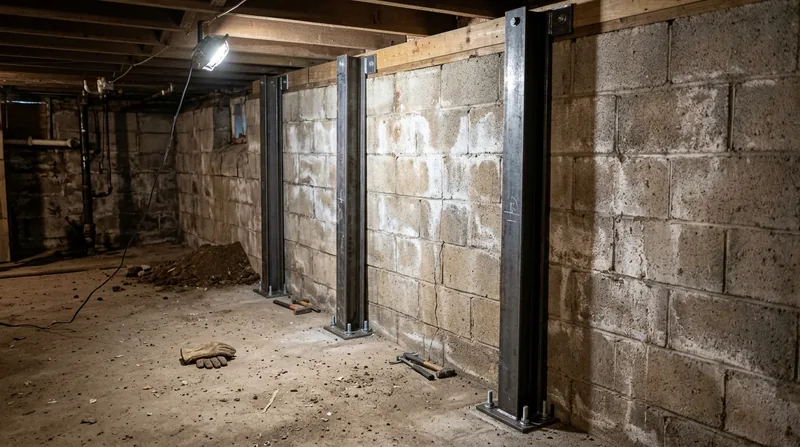




Bowing Wall Repair in Akron: Stop the Movement Before It Worsens
If you have noticed a basement wall leaning inward, a horizontal crack running along the block course, or a door frame that no longer sits square, you are looking at Bowing Wall Repair in Akron. The city sits on the Allegheny Plateau edge, where heavy glacial till clay over shale pushes against foundations across Highland Square, West Hill, Kenmore, and North Hill. Those 1900s-1930s foursquares and bungalows were built on full basements with stone, brick, or early block walls, and after a century of freeze-thaw cycles and spring snowmelt, many of those walls are moving.
We stabilize bowing and leaning foundation walls with carbon fiber straps, steel I-beams, or wall anchors, matched to how far the wall has moved and what the soil is doing. We do not sell excavation when straps will hold. We also do not strap a wall that has already lost too much of its cross-section. The right answer depends on the wall, the drainage, and the water table under your lot. Call (330) 315-1186 for a free basement inspection and a straight assessment. You can also review our foundation waterproofing approach before we ever talk about a repair method.
Why Bowing Walls Are a Real Problem in Akron's Older Basements
Akron's soil is the driver. Heavy glacial clay holds water instead of draining it, and in the lowlands near the Little Cuyahoga, Tinkers Creek, and the Portage Lakes, the water table stays high. Saturated clay exerts hydrostatic pressure against a basement wall, and older block or stone walls were never engineered for that load. Add hillside runoff from the Cuyahoga River valley and hard freeze-thaw cycles, and the wall starts to rotate inward at mid-height.
- Horizontal cracks in block or brick walls signal pressure, not settling.
- Walls that lean inward at the top usually point to anchor or tieback work.
- White efflorescence and wall seepage tell you water is already moving through the wall.
- Sticking doors and cracked interior finishes often follow the wall movement.
- Goodyear Heights and Firestone Park company-built houses from the 1910s-1920s are common candidates for stabilization.
If you see any of these signs, get the wall looked at before the movement accelerates.
Key info: A 1920s block wall in Kenmore that bows one inch over eight feet is a very different job from a 1990s poured wall in Green that has cracked but not moved. We check plumb with a level and measure the deflection before recommending straps, beams, or anchors.
For official guidance on structural permits and inspection requirements, start with the City of Akron building department, since local rules vary and must be verified before work begins.
How We Repair a Bowing Wall in Akron, Step by Step
We start below grade, not at the drywall. The first visit is a free basement inspection where we map the wall movement, check the drain tile and footing drain, and look for the water source feeding the pressure. Then we match the repair to the severity. A wall that has moved less than about two inches and is still plumb at the top is often a candidate for carbon fiber straps. A wall that has rotated further may need steel I-beams or wall anchors set into the soil outside.
- We inspect the wall, the floor, and the drainage, and we measure the deflection.
- We identify whether hydrostatic pressure, a failed drain tile, or poor grading is driving the movement.
- We install carbon fiber straps, steel I-beams, or wall anchors based on the movement and the soil.
- We address the water with an interior drain tile system or exterior drainage so the pressure does not return.
- We verify the wall is stable and explain what to watch for over the next season.
Stabilizing the wall without fixing the water is a temporary fix, and we say so plainly.
Key info: On a 1950s brick ranch in Ellet, the back wall had bowed about an inch and a half. Carbon fiber straps stabilized it, and an interior perimeter drain relieved the clay pressure that caused the movement. The homeowner avoided exterior excavation entirely.
Repair Methods We Use for Bowing Walls
No single method fits every wall. The table below shows how we match the approach to the movement and the soil conditions we find in Akron.
| Approach | Description | Best for |
|---|---|---|
| Carbon fiber straps | High-strength straps bonded to the wall to resist further inward movement. | Moderate bowing under two inches, block or poured walls. |
| Steel I-beams | Vertical steel beams anchored to floor and joists to brace the wall. | Walls with significant movement or heavy clay pressure. |
| Wall anchors | Anchors set in the soil outside pull the wall back toward plumb. | Walls that have rotated at the top and need pulling. |
| Drainage correction | Interior drain tile or exterior waterproofing to relieve hydrostatic pressure. | Walls where water is the root cause of the movement. |
We combine methods when the wall and the water both demand it, and we explain the tradeoffs before you commit.
Bowing Wall Repair Cost in Akron: What to Expect
Bowing wall repair is not a flat-rate job, and any contractor who quotes one without seeing the wall is guessing. In the Akron market, simple stabilization work can start around From $600 for limited crack and strap work, while full wall stabilization with drainage correction runs considerably higher. The wall material, the amount of deflection, the soil, and whether we need to relieve hydrostatic pressure all move the number.
We give you a written scope, not a verbal ballpark. Getting two or three estimates is smart, and we encourage you to compare what each one includes, especially whether drainage is part of the repair or an add-on later. Our pricing overview breaks down the ranges we see across Akron and the surrounding suburbs.
Finding a Bowing Wall Repair Contractor Near Me in Akron
Hiring for structural wall work is different from hiring for a cosmetic repair. You want a contractor who is licensed and insured, who will show you a certificate of insurance on request, and who will put the scope in writing. Ask for references from jobs in Akron, Cuyahoga Falls, or Fairlawn, and ask whether the repair addressed the water source or only the wall.
- Confirm the contractor is licensed and insured before any work begins.
- Get at least two or three written estimates with the same scope so you can compare.
- Ask for references on similar walls and similar soil conditions.
- Ask whether a permit is required and who pulls it with the local building department.
- Check whether drainage correction is included or priced separately.
If a contractor cannot answer those questions clearly, keep looking.
Ready to have your wall assessed? Contact us for a free basement inspection, or call (330) 315-1186. We serve Akron and the surrounding communities, and we will tell you honestly whether your wall needs stabilization or just a crack repair.
Bowing Wall Repair in Akron: Pricing Guide
| Service | Price | Details |
|---|---|---|
| Crack and strap stabilization | Starting at $600 | Covers limited carbon fiber strap work on a moderately bowed wall; deflection and wall length move the price. |
| Full wall stabilization | Starting at $2,500 | Multiple straps or steel I-beams across a longer wall; wall material and amount of movement drive the range. |
| Wall anchors with exterior work | On estimate | Requires excavation outside and anchor placement in clay soil; access and depth determine the scope. |
| Stabilization plus drainage correction | On estimate | Combines wall repair with interior drain tile or exterior waterproofing to relieve hydrostatic pressure. |
| Travel | Included | In Akron and surrounding areas, no separate call-out or mileage fee. |
| Estimate | Free | Response within 24h at (330) 315-1186, no obligation to book. |
Indicative pricing, the exact cost depends on square footage, finish, and site access. Free personalized estimate within 24h at (330) 315-1186.


