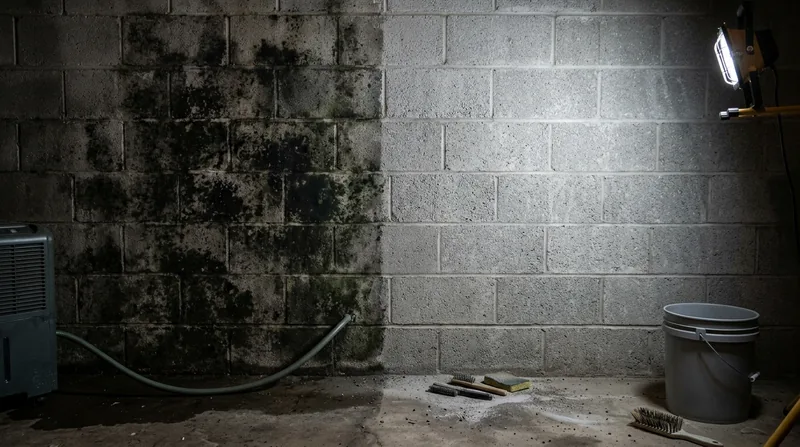




Akron sits on the edge of the Allegheny Plateau, where heavy glacial till clay and shale meet the Cuyahoga River valley, the Little Cuyahoga and Tinkers Creek. That geology sends water downhill into basements across Highland Square, West Hill, Kenmore and North Hill, where 1900s foursquares and bungalows sit on stone, brick and early block walls. If you smell that damp, earthy odor in your finished basement in Ellet or see dark staining on the drywall behind the paneling, you are likely dealing with Basement Mold Remediation in Akron, and the moisture source has to be fixed before any surface treatment will hold. We find the water entry first, then contain and treat the affected materials, and we set up drainage or dehumidification so the mold does not come back. Homeowners in Goodyear Heights and Firestone Park call us because their 1910s company-built basements stay humid through July and August. Start with a free basement inspection so we can trace the moisture before we quote anything.
Why Akron Basements Grow Mold: Glacial Clay, Old Walls and Wet Summers
Most of the mold calls we run in Akron trace back to hydrostatic pressure against stone and brick walls, not to a single leak. The clay till here holds water against the foundation long after a storm passes, and older mortar joints wick that moisture inward. Add the hard freeze-thaw cycles and spring snowmelt, and the wall stays wet for weeks. When the basement is finished, as in the 1950s to 1970s brick ranches across Fairlawn and Cuyahoga Falls, the drywall traps that moisture against the block.
- Efflorescence and white salt bloom on the wall means water is moving through the masonry right now.
- A musty basement smell that gets stronger after rain points to damp framing and carpet, not just surface mold.
- Peeling paint and soft drywall at the base of a wall show moisture wicking up from the floor slab.
- High humidity in a finished basement in Green or Stow keeps condensation on cold ducts and rim joists.
- Water staining inside a window well in Kenmore or North Hill often means the well is not draining away from the wall.
Treating the visible mold without fixing the water path just buys you a few months. The Akron building department publishes permit guidance for work that alters drainage or foundation repair, and it is worth checking before any structural work starts.
Key info: A 1920s foursquare in Goodyear Heights with block walls and a finished lower level is the classic Akron mold case. The block wicks groundwater, the drywall holds it, and the musty smell shows up every July. Sealing the interior wall without addressing the drain tile and sump is the wrong order of work.
How We Run Basement Mold Remediation in Akron Homes
We work from the water backward. The first step is finding where the moisture enters, because mold remediation that skips that step fails in the same spot the next wet season. We inspect the wall base, the floor joint, the window wells and the sump basin, and we check the humidity with a meter rather than by eye. Then we contain the area, treat the affected surfaces, and correct the moisture path with drainage, wall sealing or a dehumidification setup.
- We walk the basement and map every moisture reading, including the wall base, rim area and any finished surfaces.
- We set up containment with plastic sheeting and negative air pressure so spores do not spread into the rest of the house.
- We remove porous materials that cannot be cleaned, such as soaked drywall, insulation and carpet padding.
- We treat the framing, block and concrete with an approved antimicrobial and HEPA-vacuum the surfaces.
- We correct the moisture source with interior drain tile, wall sealing, a sump pump upgrade or window well drainage.
- We verify dryness with a moisture meter and give you a written summary of what was done and what to watch.
The moisture correction step is what makes the remediation last, and it is the part most homeowners underestimate when they call around.
Key info: A finished basement in Cuyahoga Falls had mold along the bottom two feet of the paneled wall and a musty smell every spring. The cause was a failed footing drain and a sump pump that short-cycled. We remediated the wall, replaced the pump and tied it to a interior drain tile system, and the wall stayed dry through the next snowmelt.
Mold Treatment Approaches We Use in Akron Basements
Not every basement needs the same scope. A small patch of surface mold on a block wall in Highland Square is a different job from a finished lower level in Hudson with soaked drywall and a wet carpet. The table below shows how we match the approach to the condition we find.
| Approach | Description | Best for |
|---|---|---|
| Surface treatment and cleaning | HEPA vacuum, antimicrobial wash and seal on block or concrete. | Light surface mold on unfinished walls with a fixable moisture source. |
| Containment and material removal | Plastic sheeting, negative air, removal of soaked drywall and insulation. | Finished basements with mold behind paneling or under carpet. |
| Drainage correction | Interior perimeter drain, sump basin and discharge line work. | Hydrostatic pressure and water at the wall base after rain. |
| Wall sealing and vapor control | Crack injection, masonry sealing and a vapor barrier on damp walls. | Wicking block and brick walls with efflorescence. |
| Humidity control | Dehumidifier sizing and ventilation guidance for damp summers. | Finished basements that stay humid without standing water. |
We pick the lightest approach that actually solves the moisture problem, and we tell you when simple cleaning is enough.
Basement Mold Remediation Cost in Akron: What to Expect
Most Akron mold remediation jobs start around $1,500, and that figure covers a contained work area with surface treatment and HEPA cleanup. The number climbs when we have to open finished walls, remove soaked drywall and carpet, or add drainage work to stop the water from returning. A single damp wall in a Norton ranch is a different scope from a full finished basement in Hudson.
- The size of the affected area drives the labor and the containment setup.
- Whether the walls are finished or bare changes the removal and rebuild scope.
- The moisture fix itself, such as drain tile, a sump pump or wall sealing, is often the larger line item.
- Access and parking matter in dense blocks of West Hill and North Hill.
- Emergency calls after a storm or a sump failure carry a scheduling premium.
Get two or three estimates and ask each contractor to explain the moisture source, not just the mold cleanup. Our full pricing overview shows how the pieces fit together.
Hiring Basement Mold Remediation Near Me in Akron: What to Check
You want a contractor who treats the moisture, not just the stain. Ask any company near Akron how they will find the water source and what happens if the mold returns after a wet spring. A written scope that separates remediation from the drainage fix is a good sign.
- Confirm the company is licensed and insured and ask for a certificate before work starts.
- Get two or three written estimates with the same scope so you can compare them fairly.
- Ask for references from Akron jobs with the same wall type and basement finish as yours.
- Check whether the work needs a permit from the local building department, since rules vary.
- Ask whether the company handles the moisture correction or only the surface cleanup.
If a contractor will not explain the moisture path in plain language, keep calling. Reach us through the contact page and we will walk the basement with you.
Basement Mold Remediation in Akron: Pricing Guide
| Service | Price | Details |
|---|---|---|
| Surface mold treatment | Starting at $1,500 | Containment, HEPA vacuum and antimicrobial treatment on unfinished walls with a fixable moisture source. |
| Finished basement remediation | Starting at $2,800 | Removal of soaked drywall and insulation, containment and treatment; scope grows with square footage affected. |
| Remediation plus drainage fix | On estimate | Interior drain tile, sump work or wall sealing added to the cleanup; needs an on-site look first. |
| Travel | Included | in Akron and surrounding areas, no separate call-out or mileage fee |
| Estimate | Free | Response within 24h at (330) 315-1186, no obligation to book |
Indicative pricing, the exact cost depends on square footage, finish, and site access. Free personalized estimate within 24h at (330) 315-1186.


