



Drain Tile Repair & Replacement in Akron: Restoring the Drainage Your Foundation Was Built On
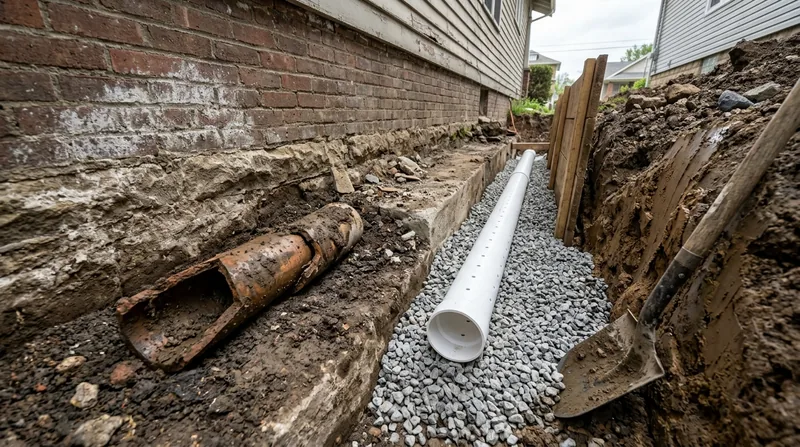
Akron sits on the edge of the Allegheny Plateau, where heavy glacial till clay lies over shale and the Cuyahoga River, Little Cuyahoga and Tinkers Creek cut deep valleys through the city. That geology decides how water moves under your house. In the lowlands and around the Portage Lakes the water table stays high, and hillside runoff from West Hill, North Hill and the Ellet bluffs pushes groundwater toward foundations all spring. Most of the housing stock here was built between the 1900s and the 1950s, and a large share of those foursquares, bungalows and Tudors still drain through the original clay tile footing drain laid under the basement floor. Drain Tile Repair & Replacement in Akron is the work of finding out whether that drain still functions, and replacing it with modern PVC when it does not.
Clay tile fails predictably. The joints separate as the ground moves through hard freeze-thaw cycles, roots from old maples and sycamores work into the seams, and the pipe silts up until it carries nothing. Water then has nowhere to go but up through the slab or against the wall. We camera the line, locate the break, and either repair a short run or replace the full perimeter with perforated PVC set in washed stone and wrapped in filter fabric. If your basement takes on water after a summer storm, start with a free basement inspection so we can see what the drain is actually doing.
Why Failed Drain Tile Is the Root Cause of So Many Wet Basements in Akron
When a homeowner in Kenmore or Goodyear Heights calls about a wet basement, the sump pump usually gets blamed first. In our experience the pump is often fine, and the real problem is a footing drain that stopped draining years ago. Water backs up in the gravel bed, saturates the glacial clay around the footing, and the hydrostatic pressure finds every cold joint, tie hole and mortar joint in the wall. That is why you see efflorescence blooming on block walls in Firestone Park houses and why the musty basement smell returns every July no matter how many times the floor gets mopped.
- Original clay tile from the 1920s through the 1950s has separated joints that let soil and roots into the line.
- Tree roots from mature street trees crush and infiltrate shallow footing drains along older Akron lots.
- Glacial clay soil holds water instead of draining it, so a failed line saturates the footing backfill fast.
- Spring snowmelt and heavy summer storms overwhelm a partially clogged drain and push water through the slab.
- Hillside runoff in West Hill and North Hill adds surface water the original drain was never sized to handle.
Repairing the drain addresses the source. Sealing the wall without fixing the drain just traps the pressure behind a fresh coat of parging.
Key info: A 1926 foursquare in Highland Square had a sump pit that ran every 20 minutes during a June storm. The pump was two years old. The camera showed the original clay tile crushed under a maple root about 14 feet from the basin. Replacing that run dropped the pump cycle to once every few hours.
Permits for work that alters drainage or the sanitary connection of a sump discharge vary by jurisdiction, so confirm the current requirement with the City of Akron building department before scheduling.
How We Diagnose and Replace a Failed Footing Drain in Akron
We do not quote a drain replacement from the driveway. The first step is proving what is wrong, because a clogged line, a collapsed line and a line that was simply undersized from the start call for different work. On a 1950s brick ranch in Cuyahoga Falls, the fix might be a targeted excavation of 20 feet. On a 1920s block-wall house in North Hill, the honest answer is often a full interior perimeter drain because the original tile is gone everywhere. Either way, here is the sequence we follow.
- We camera the existing drain line from the sump basin or a cleanout and record the condition, slope and location of every break.
- We mark the failure points on the floor and check the wall for efflorescence, crack patterns and evidence of hydrostatic pressure.
- We cut and remove the slab or excavate at the footing, depending on whether the repair is interior or exterior.
- We replace the failed run with perforated PVC set in washed stone, wrapped in filter fabric, and pitched to the basin.
- We tie the new line into the sump basin, verify the check valve and discharge line, and run water through the system before backfilling.
- We pour a clean concrete patch and leave the basement ready to use.
Where the drain is sound but the wall still seeps, the right answer may be an interior drain tile system that captures water at the wall-floor joint instead of relying on the old footing line at all.
Key info: A 1998 Colonial in Green had a poured wall, a dry basement for 20 years, and then a wet carpet every March. The footing drain was fine. The problem was grading that had settled against the foundation and a downspout discharging two feet from the wall. We reset the grade, extended the discharge, and the basement stayed dry through the next snowmelt.
Repair, Replace or Reroute: Matching the Method to the Failure
Not every drain problem needs a full replacement, and we will tell you when a smaller scope will do the job. The table below shows how we match the approach to what the camera and the wall tell us. The decision usually comes down to how much of the original line is still serviceable and whether the water is entering at the footing or higher up the wall.
| Approach | Description | Best for |
|---|---|---|
| Targeted drain repair | Excavate and replace a short failed run, typically 10 to 30 feet, and tie back into sound tile. | One isolated break or root intrusion on an otherwise working line. |
| Full interior perimeter drain | Cut the slab at the wall and install new perforated PVC pitched to a sump basin. | Failed clay tile throughout, or water entering at the wall-floor joint. |
| Exterior footing drain replacement | Excavate outside to the footing, replace the drain, and add dimple board and membrane. | Collapsed exterior line where access allows and the wall needs exterior work. |
| Drain cleaning and rerouting | Jet the line, correct the pitch, and reroute discharge away from the foundation. | Silted but intact tile, or a discharge line that dumps too close to the wall. |
If the drain is sound but the sump pump is aging out, a sump pump replacement is the cheaper and more sensible call.
Drain Tile Repair & Replacement Cost in Akron: What to Expect
Pricing for drain tile work starts at From $750 for a small targeted repair, and most full replacements in the Akron metro land well above that. The spread is wide because the work is different house to house. A 25-foot repair on a 1965 ranch in Ellet is not the same job as a full perimeter replacement under a 1922 foursquare in West Hill with a finished basement and a stone wall. We give a firm number after the camera inspection, not before.
The main cost drivers are the length of line being replaced, whether the slab has to be cut and repoured, whether the basement is finished, how deep the footing sits, and whether tree roots have to be cut out before excavation. Access matters too: a house with a driveway tight against the foundation is a harder exterior dig than one with a clear side yard. Getting two or three written estimates is smart, and make sure each one is quoting the same scope, because a low number that only cleans the line is not the same as a replacement. Our full pricing overview breaks down the ranges by method.
Drain Tile Repair & Replacement Near Me: How to Vet an Akron Contractor
Drain tile work is below-grade, invisible when it is done, and easy to do badly. A contractor who cleans a line and calls it a replacement has left you with the same failing tile under a fresh concrete patch. Ask for proof of licensing and insurance, get the certificate sent to you directly, and ask how many drain replacements the crew has done on Akron's older stone and block foundations.
- Confirm the company carries current liability insurance and workers' compensation and ask for a certificate.
- Get two or three written estimates that list the same scope so you are comparing like for like.
- Ask for local references from jobs in Akron, Cuyahoga Falls or Tallmadge and call them.
- Ask whether a permit is required for the drainage or discharge work and who pulls it.
- Get the warranty terms in writing, including whether it is transferable if you sell the house.
If a contractor will not put the scope and the warranty in writing, keep looking. You can request a free estimate and we will show you the camera footage before we quote anything.
Drain Tile Repair & Replacement in Akron: Pricing Guide
| Service | Price | Details |
|---|---|---|
| Targeted drain tile repair | Starting at $750 | Covers camera inspection and replacement of a short failed run, typically 10 to 30 feet of PVC. |
| Full interior perimeter drain | Starting at $4,500 | Includes slab cutting, new perforated PVC, washed stone, filter fabric and tie-in to the sump basin. |
| Exterior footing drain replacement | On estimate | Excavation depth, access around the foundation and the length of line drive the number. |
| Drain cleaning and rerouting | Starting at $450 | Jetting the existing line, correcting pitch and rerouting discharge away from the foundation. |
| Travel | Included | In Akron and surrounding areas, no separate call-out or mileage fee. |
| Estimate | Free | Response within 24h at (330) 315-1186, no obligation to book. |
Indicative pricing, the exact cost depends on square footage, finish, and site access. Free personalized estimate within 24h at (330) 315-1186.


